
Global Wholesale & Professional Supply

Languages

Cart

Your shopping cart doesn't have any products yet!
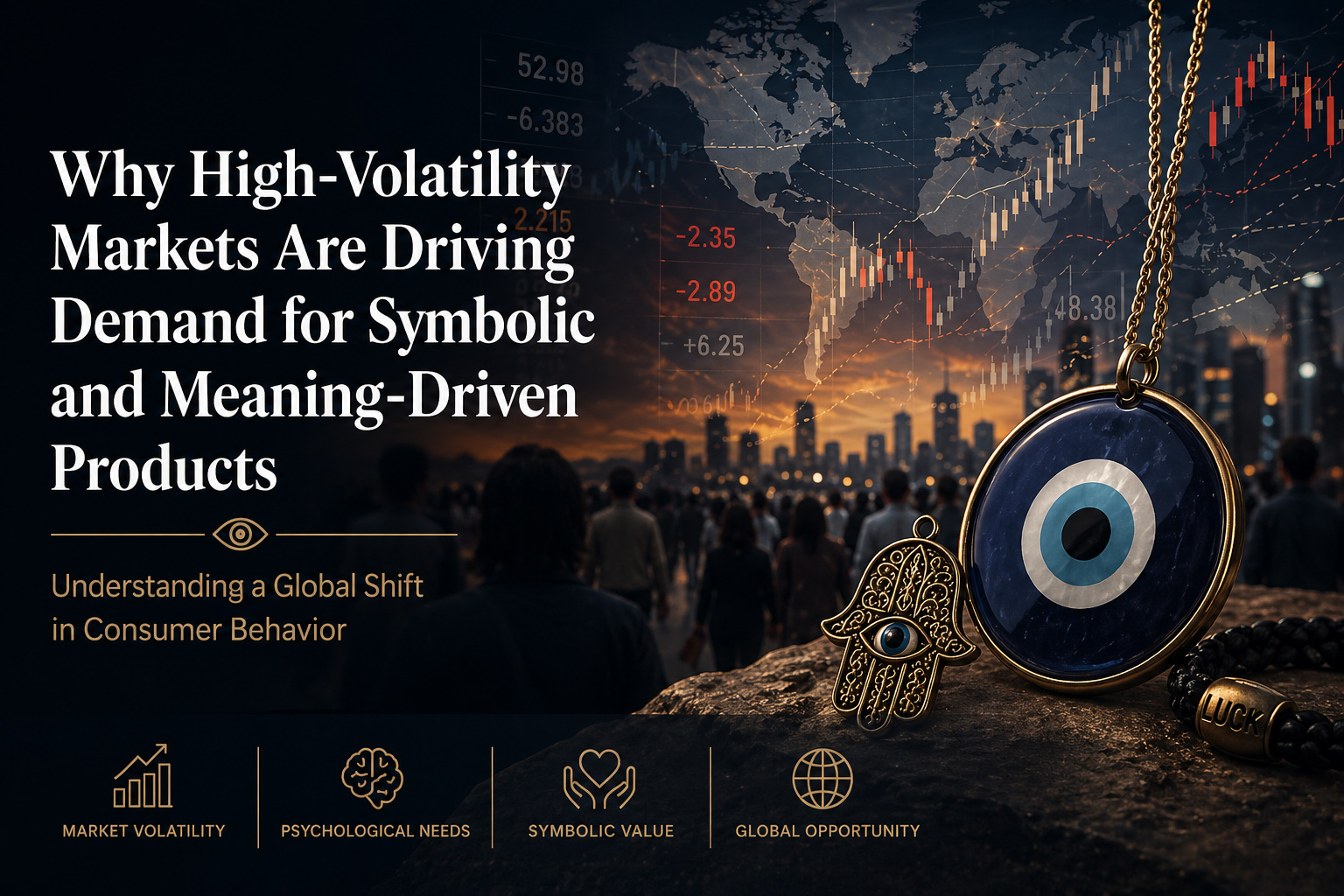
Why High-Volatility Markets Are Driving Demand for Symbolic and Meaning-Driven Products

Why High-Volatility Markets Are Driving Demand for Symbolic and Meaning-Driven Products

Apr 26, 2026

Why High-Volatility Markets Are Driving Demand for Symbolic and Meaning-Driven Products


Global markets are entering a phase defined by acceleration, expansion, and instability.


Artificial intelligence, electronics, and digital infrastructure are growing at unprecedented speed. Capital flows rapidly into emerging sectors. Information spreads instantly across networks. New opportunities appear quickly—but so do risks.


This environment is not only transforming industries.

It is also reshaping how people think, feel, and make decisions.


Interestingly, while this pattern is widely recognized in modern economic and technological terms, it closely aligns with a traditional Eastern framework that describes periods of rapid expansion as having “fire-like” characteristics—intense, fast-moving, and inherently unstable.


While this framework is not a global consensus, it offers a useful lens for understanding current market behavior.
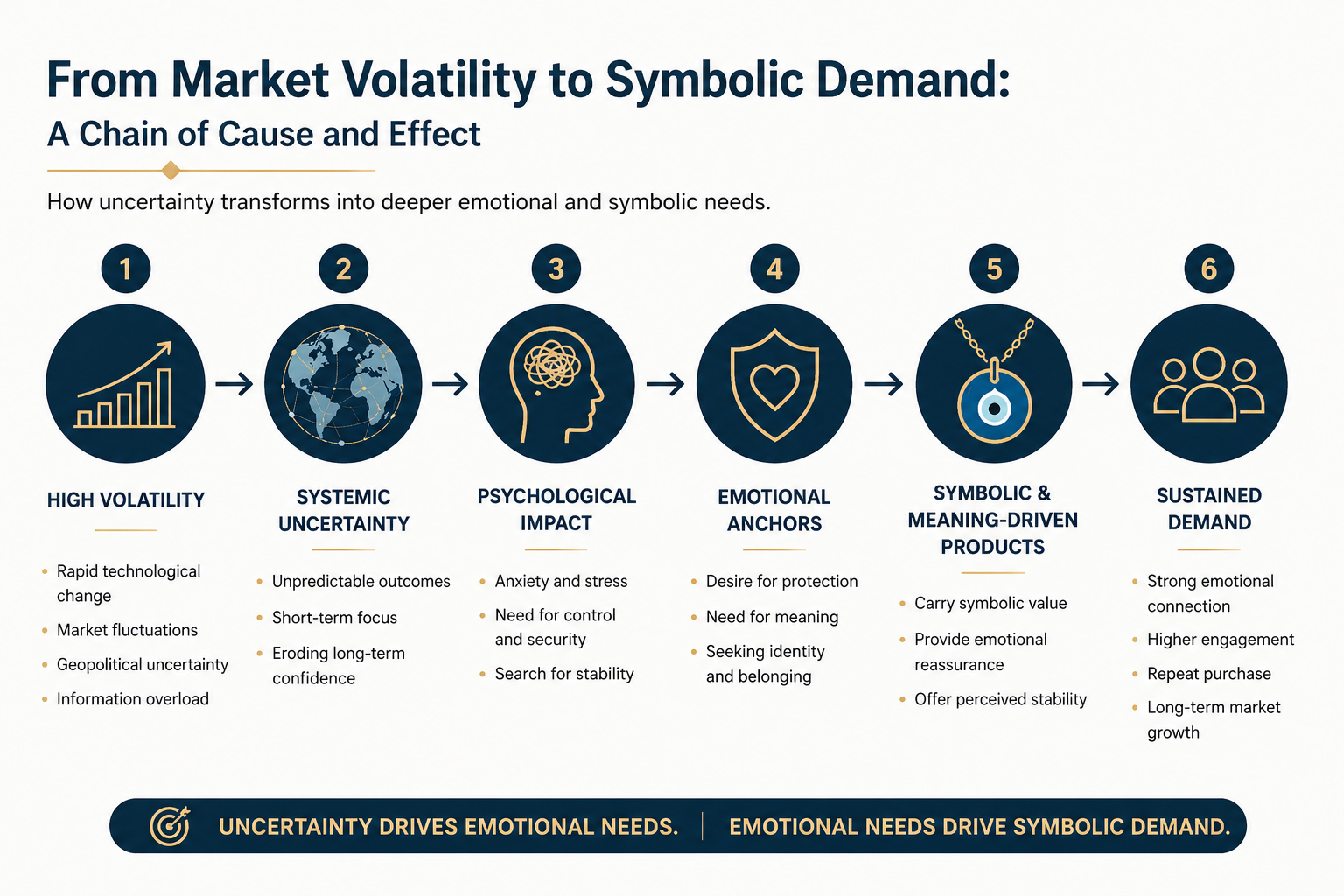
market-volatility-to-symbolic-demand-cause-effect-framework.jpg

1. Technology and Electronics: Acceleration with Instability


The AI and electronics supply chains are at the center of current growth.


  • Semiconductor demand is surging

  • Data infrastructure is expanding globally

  • AI applications are rapidly commercializing


However, this growth comes with:


  • Valuation volatility

  • Rapid product cycles

  • Unpredictable demand shifts


In modern terms, this reflects a high-liquidity, innovation-driven cycle.


In Eastern frameworks, this resembles a “fire-dominant phase”—fast expansion with fluctuating stability.


For distributors and retailers, this means:


Growth opportunities are significant

But structural control becomes critical


2. Financial Markets: Speed, Narrative, and Volatility


Global capital markets are increasingly driven by:


  • Narratives (AI, crypto, emerging tech)

  • Short-term momentum

  • Rapid capital rotation


Price movements are often disconnected from underlying fundamentals in the short term.


This creates:


  • Sharp upward spikes

  • Sudden corrections

  • Heightened emotional participation


From a structural perspective:


Markets are becoming more reactive and less stable


This aligns with the same “fast but unstable” pattern observed across sectors.


3. Consumer Psychology: From Rational Choice to Emotional Response


As external environments become less predictable, consumer behavior shifts.


Consumers are no longer driven purely by:


  • Function

  • Price

  • Utility


Instead, there is increasing demand for:


  • Emotional reassurance

  • Personal meaning

  • Psychological comfort


This is particularly visible in regions experiencing rapid social and economic change, including parts of the Middle East and Latin America.


4. The Rise of Symbolic and Meaning-Driven Products


In uncertain environments, demand shifts toward products that offer more than function.


Examples include:


  • Symbolic jewelry

  • Protective motifs (such as the evil eye)

  • Spiritual and cultural objects

  • Personalized items with meaning


These products serve a different role:


They provide perceived stability

They offer emotional anchoring

They create a sense of control


From a market perspective, this is not a niche trend.


It is a structural response to uncertainty.


5. Cross-Cultural Convergence: Different Languages, Same Behavior


While the terminology differs across cultures, the underlying pattern is consistent:


  • In modern economics: high volatility cycles

  • In psychology: uncertainty-driven behavior

  • In Eastern philosophy: “fire-like” expansion phases


These are not conflicting explanations.


They are different ways of describing the same phenomenon:


Rapid expansion increases both opportunity and instability

Instability increases demand for psychological and symbolic support


Conclusion: From Function to Meaning in High-Volatility Cycles


As markets become faster and less predictable, demand is evolving.


Functional products remain important—but they are no longer sufficient.


Consumers, distributors, and retailers are increasingly responding to:


  • Volatility

  • Emotional uncertainty

  • Lack of long-term predictability


In this environment, symbolic and meaning-driven products are not optional.


They are becoming part of a broader demand structure.


For businesses operating in cross-border wholesale, especially in regions such as the Middle East and Latin America, understanding this shift is critical.


Because in high-volatility systems:


Stability is not only built through logistics and supply chains

It is also supported through meaning, perception, and emotional structure


We use cookie to improve your online experience. By continuing to browse this website, you agree to our use of cookie.

Cookies

Please read our Terms and Conditions and this Policy before accessing or using our Services. If you cannot agree with this Policy or the Terms and Conditions, please do not access or use our Services. If you are located in a jurisdiction outside the European Economic Area, by using our Services, you accept the Terms and Conditions and accept our privacy practices described in this Policy.
We may modify this Policy at any time, without prior notice, and changes may apply to any Personal Information we already hold about you, as well as any new Personal Information collected after the Policy is modified. If we make changes, we will notify you by revising the date at the top of this Policy. We will provide you with advanced notice if we make any material changes to how we collect, use or disclose your Personal Information that impact your rights under this Policy. If you are located in a jurisdiction other than the European Economic Area, the United Kingdom or Switzerland (collectively “European Countries”), your continued access or use of our Services after receiving the notice of changes, constitutes your acknowledgement that you accept the updated Policy. In addition, we may provide you with real time disclosures or additional information about the Personal Information handling practices of specific parts of our Services. Such notices may supplement this Policy or provide you with additional choices about how we process your Personal Information.


Cookies

Cookies are small text files stored on your device when you access most Websites on the internet or open certain emails. Among other things, Cookies allow a Website to recognize your device and remember if you've been to the Website before. Examples of information collected by Cookies include your browser type and the address of the Website from which you arrived at our Website as well as IP address and clickstream behavior (that is the pages you view and the links you click).We use the term cookie to refer to Cookies and technologies that perform a similar function to Cookies (e.g., tags, pixels, web beacons, etc.). Cookies can be read by the originating Website on each subsequent visit and by any other Website that recognizes the cookie. The Website uses Cookies in order to make the Website easier to use, to support a better user experience, including the provision of information and functionality to you, as well as to provide us with information about how the Website is used so that we can make sure it is as up to date, relevant, and error free as we can. Cookies on the Website We use Cookies to personalize your experience when you visit the Site, uniquely identify your computer for security purposes, and enable us and our third-party service providers to serve ads on our behalf across the internet.

We classify Cookies in the following categories:
 ●  Strictly Necessary Cookies
 ●  Performance Cookies
 ●  Functional Cookies
 ●  Targeting Cookies


Cookie List
A cookie is a small piece of data (text file) that a website – when visited by a user – asks your browser to store on your device in order to remember information about you, such as your language preference or login information. Those cookies are set by us and called first-party cookies. We also use third-party cookies – which are cookies from a domain different than the domain of the website you are visiting – for our advertising and marketing efforts. More specifically, we use cookies and other tracking technologies for the following purposes:

Strictly Necessary Cookies
These cookies are necessary for the website to function and cannot be switched off in our systems. They are usually only set in response to actions made by you which amount to a request for services, such as setting your privacy preferences, logging in or filling in forms. You can set your browser to block or alert you about these cookies, but some parts of the site will not then work. These cookies do not store any personally identifiable information.

Functional Cookies
These cookies enable the website to provide enhanced functionality and personalisation. They may be set by us or by third party providers whose services we have added to our pages. If you do not allow these cookies then some or all of these services may not function properly.

Performance Cookies
These cookies allow us to count visits and traffic sources so we can measure and improve the performance of our site. They help us to know which pages are the most and least popular and see how visitors move around the site. All information these cookies collect is aggregated and therefore anonymous. If you do not allow these cookies we will not know when you have visited our site, and will not be able to monitor its performance.

Targeting Cookies
These cookies may be set through our site by our advertising partners. They may be used by those companies to build a profile of your interests and show you relevant adverts on other sites. They do not store directly personal information, but are based on uniquely identifying your browser and internet device. If you do not allow these cookies, you will experience less targeted advertising.

How To Turn Off Cookies
You can choose to restrict or block Cookies through your browser settings at any time. Please note that certain Cookies may be set as soon as you visit the Website, but you can remove them using your browser settings. However, please be aware that restricting or blocking Cookies set on the Website may impact the functionality or performance of the Website or prevent you from using certain services provided through the Website. It will also affect our ability to update the Website to cater for user preferences and improve performance. Cookies within Mobile Applications

We only use Strictly Necessary Cookies on our mobile applications. These Cookies are critical to the functionality of our applications, so if you block or delete these Cookies you may not be able to use the application. These Cookies are not shared with any other application on your mobile device. We never use the Cookies from the mobile application to store personal information about you.

If you have questions or concerns regarding any information in this Privacy Policy, please contact us by email at . You can also contact us via our customer service at our Site.