
Cart
Your shopping cart doesn't have any products yet!
⸻
Retail Stability as an Outcome of Structured Wholesale Systems
In global wholesale systems, stability is often misunderstood.
Many businesses measure stability based on inventory levels, shipment volume, or operational scale. However, these indicators do not reflect the true performance of a wholesale system.
The real measure of stability lies in retail.
⸻
Moving Beyond Volume-Based Thinking
Wholesale success is frequently associated with growth in order volume or expansion across markets.
While these factors indicate activity, they do not guarantee stable outcomes. Large volumes can still result in inconsistent retail performance if inventory is not properly distributed or timed.
Stability is not defined by how much moves through the system, but by how consistently products sell through at the retail level.
⸻
The Consequences of Unstructured Systems
Without structured wholesale systems, retail performance becomes unstable.
Inventory may arrive too early or too late. Certain markets may experience oversupply, while others face shortages. Pricing can become inconsistent, and retailers may lose confidence in supply reliability.
In such environments, sell-through becomes unpredictable.
⸻
From Structure to Retail Outcomes
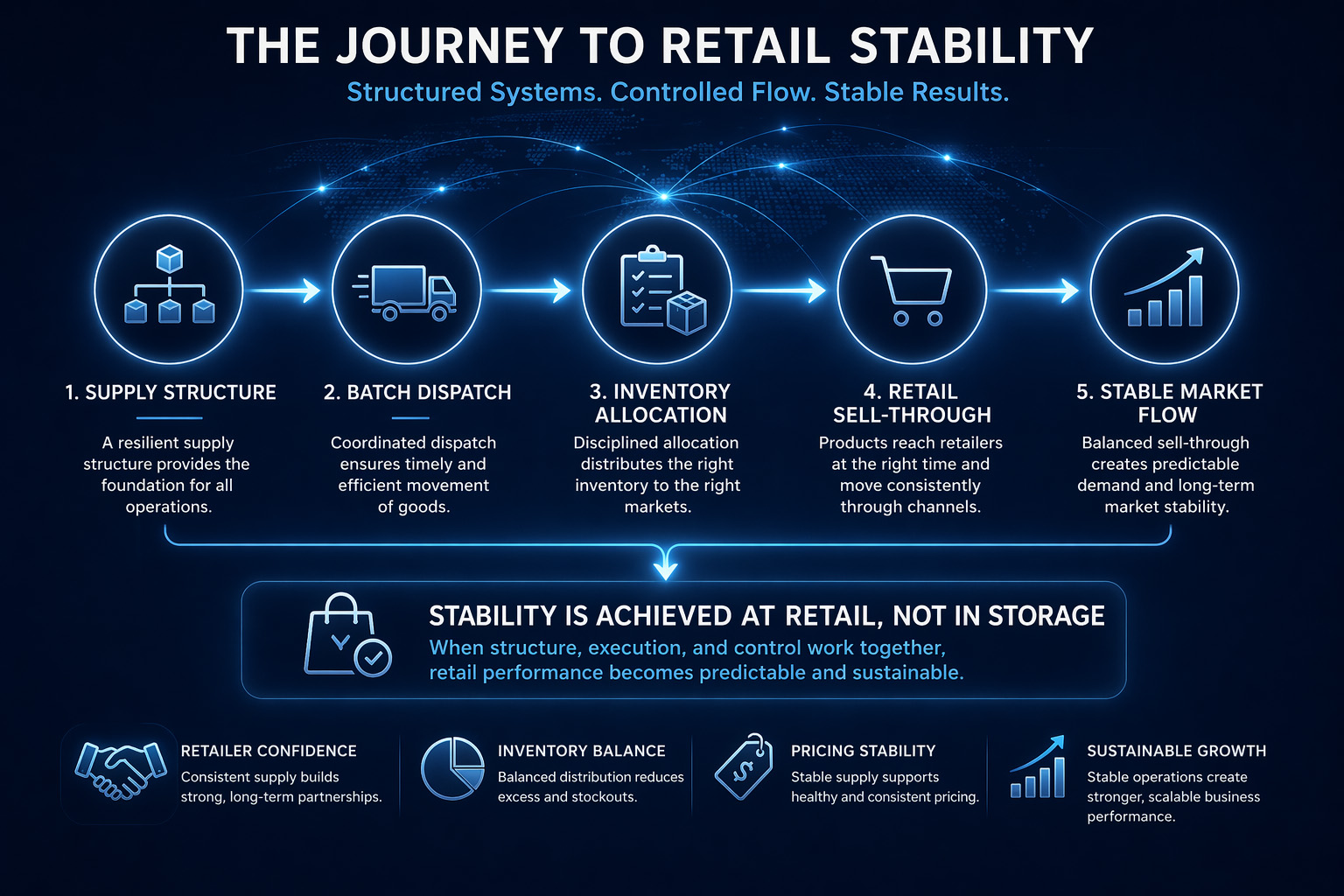
Structured wholesale systems are designed to create controlled flow.
Supply chain structures define how goods are sourced and positioned.
Batch-based dispatch controls how goods move.
Inventory allocation determines where goods are distributed.
Together, these elements transform fragmented operations into coordinated systems.
⸻
Achieving Predictable Sell-Through
When structure, execution, and control are aligned, retail outcomes become more predictable.
Products arrive at the right markets, in the right quantities, and at the right time. Retailers can maintain consistent inventory levels, support stable pricing, and improve sell-through performance.
This alignment reduces volatility and strengthens retail operations.
⸻
Retail Stability as a System Outcome
Retail stability is not created at the warehouse level.
It is the result of a complete system working in coordination.
When wholesale operations are structured effectively, stability emerges naturally at the retail level as a measurable outcome.
⸻
Conclusion
In global wholesale distribution, stability is not achieved through volume alone.
It is achieved through structured systems that coordinate supply, movement, and allocation.
Retail stability represents the final outcome of these systems—where controlled operations translate into consistent market performance and long-term business sustainability.
⸻