
Venta Mayorista Global y Suministro Profesional

Cart

Your shopping cart doesn't have any products yet!

Por qué los mercados de alta volatilidad impulsan la demanda de productos simbólicos y con significado

Por qué los mercados de alta volatilidad impulsan la demanda de productos simbólicos y con significado

Apr 26, 2026

Por qué los mercados de alta volatilidad impulsan la demanda de productos simbólicos y con significado


Los mercados globales están entrando en una fase definida por la aceleración, la expansión y la inestabilidad.


La inteligencia artificial, la electrónica y la infraestructura digital crecen a una velocidad sin precedentes. El capital fluye rápidamente hacia sectores emergentes. La información se propaga instantáneamente. Surgen nuevas oportunidades, pero también nuevos riesgos.


Este entorno no solo transforma las industrias.

También está redefiniendo cómo las personas piensan, sienten y toman decisiones.


Curiosamente, aunque este patrón es ampliamente reconocido en términos económicos y tecnológicos modernos, también se alinea con marcos tradicionales orientales que describen los periodos de expansión acelerada como fases con características “tipo fuego”: intensas, rápidas e inherentemente inestables.


Si bien este marco no representa un consenso global, ofrece una perspectiva útil para comprender el comportamiento actual del mercado.
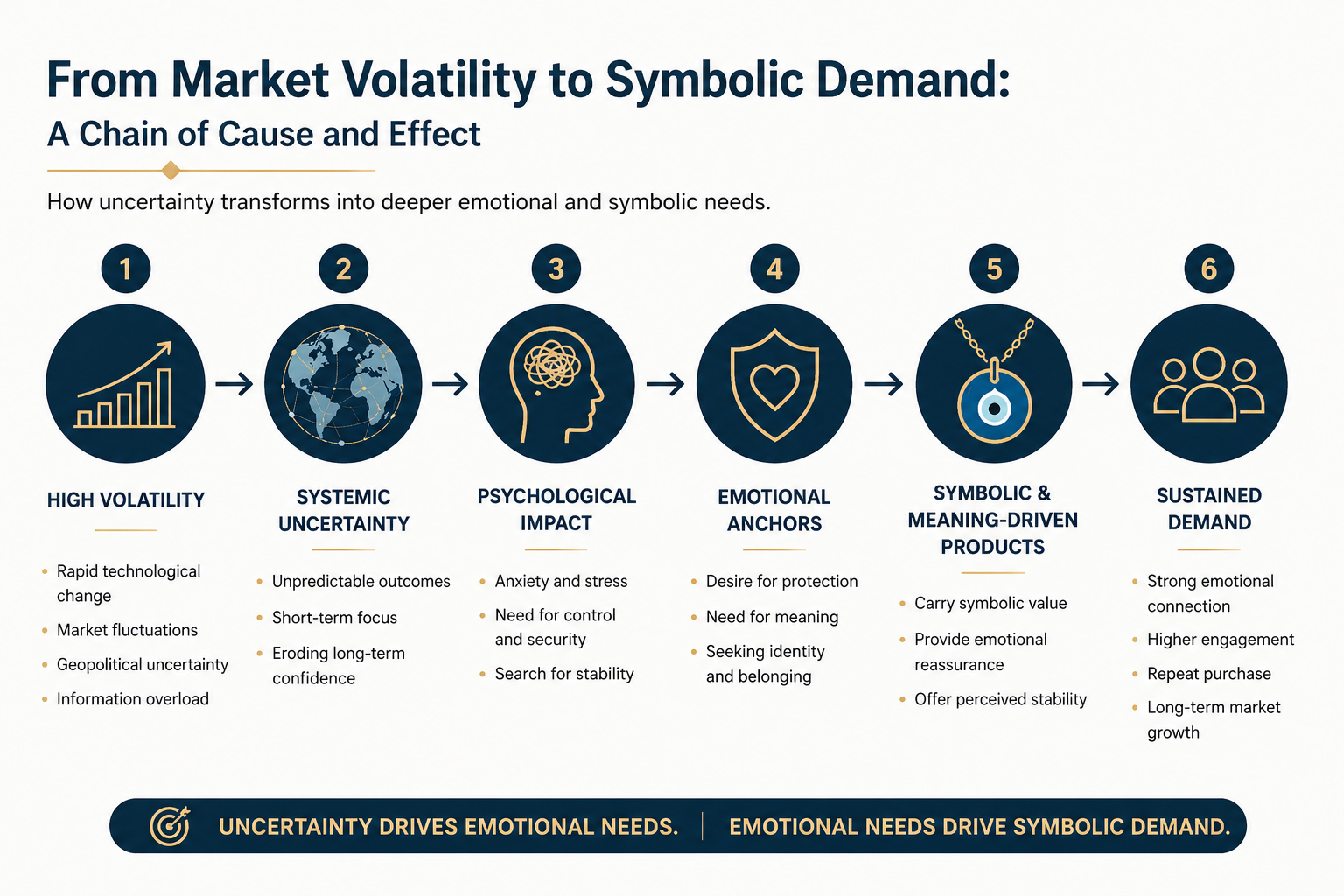
market-volatility-to-symbolic-demand-cause-effect-framework.jpg

1. Tecnología y Electrónica: Aceleración con Inestabilidad


Las cadenas de suministro de inteligencia artificial y electrónica se encuentran en el centro del crecimiento actual.


• La demanda de semiconductores está en aumento

• La infraestructura de datos se expande a nivel global

• Las aplicaciones de IA se comercializan rápidamente


Sin embargo, este crecimiento conlleva:


• Volatilidad en las valoraciones

• Ciclos de producto acelerados

• Cambios impredecibles en la demanda


En términos modernos, esto refleja un ciclo impulsado por liquidez e innovación.


En marcos orientales, se asemeja a una fase dominada por el “fuego”: expansión rápida con estabilidad fluctuante.


Para distribuidores y minoristas, esto implica:


Grandes oportunidades de crecimiento

Pero una necesidad crítica de control estructural


2. Mercados Financieros: Velocidad, Narrativa y Volatilidad


Los mercados globales de capital están cada vez más impulsados por:


• Narrativas (IA, criptomonedas, tecnologías emergentes)

• Impulso de corto plazo

• Rotación rápida de capital


Los movimientos de precios a menudo se desconectan de los fundamentos en el corto plazo.


Esto genera:


• Subidas abruptas

• Correcciones repentinas

• Participación emocional elevada


Desde una perspectiva estructural:


Los mercados se vuelven más reactivos y menos estables


3. Psicología del Consumidor: De la Razón a la Emoción


A medida que el entorno se vuelve menos predecible, el comportamiento del consumidor cambia.


Los consumidores ya no se guían únicamente por:


• Función

• Precio

• Utilidad


Ahora buscan:


• Seguridad emocional

• Significado personal

• Confort psicológico


Esto es especialmente visible en regiones como Medio Oriente y América Latina.


4. El Auge de los Productos Simbólicos


En entornos inciertos, la demanda se desplaza hacia productos que ofrecen más que funcionalidad.


Ejemplos incluyen:


• Joyería simbólica

• Motivos de protección (como el mal de ojo)

• Objetos espirituales y culturales

• Productos personalizados con significado


Estos productos:


Proporcionan estabilidad percibida

Actúan como anclas emocionales

Generan sensación de control


No es una tendencia de nicho.

Es una respuesta estructural a la incertidumbre.


5. Convergencia Cultural


Aunque las terminologías difieren, el patrón es consistente:


• Economía: ciclos de alta volatilidad

• Psicología: comportamiento bajo incertidumbre

• Filosofía oriental: fases “tipo fuego”


Diferentes lenguajes, mismo fenómeno


Conclusión


En mercados inciertos, la demanda evoluciona.


La funcionalidad ya no es suficiente.


Las empresas deben responder a:


• Volatilidad

• Incertidumbre emocional

• Falta de previsibilidad


La estabilidad ya no es solo logística

También es psicológica y simbólica


We use cookie to improve your online experience. By continuing to browse this website, you agree to our use of cookie.

Cookies

Please read our Terms and Conditions and this Policy before accessing or using our Services. If you cannot agree with this Policy or the Terms and Conditions, please do not access or use our Services. If you are located in a jurisdiction outside the European Economic Area, by using our Services, you accept the Terms and Conditions and accept our privacy practices described in this Policy.
We may modify this Policy at any time, without prior notice, and changes may apply to any Personal Information we already hold about you, as well as any new Personal Information collected after the Policy is modified. If we make changes, we will notify you by revising the date at the top of this Policy. We will provide you with advanced notice if we make any material changes to how we collect, use or disclose your Personal Information that impact your rights under this Policy. If you are located in a jurisdiction other than the European Economic Area, the United Kingdom or Switzerland (collectively “European Countries”), your continued access or use of our Services after receiving the notice of changes, constitutes your acknowledgement that you accept the updated Policy. In addition, we may provide you with real time disclosures or additional information about the Personal Information handling practices of specific parts of our Services. Such notices may supplement this Policy or provide you with additional choices about how we process your Personal Information.


Cookies

Cookies are small text files stored on your device when you access most Websites on the internet or open certain emails. Among other things, Cookies allow a Website to recognize your device and remember if you've been to the Website before. Examples of information collected by Cookies include your browser type and the address of the Website from which you arrived at our Website as well as IP address and clickstream behavior (that is the pages you view and the links you click).We use the term cookie to refer to Cookies and technologies that perform a similar function to Cookies (e.g., tags, pixels, web beacons, etc.). Cookies can be read by the originating Website on each subsequent visit and by any other Website that recognizes the cookie. The Website uses Cookies in order to make the Website easier to use, to support a better user experience, including the provision of information and functionality to you, as well as to provide us with information about how the Website is used so that we can make sure it is as up to date, relevant, and error free as we can. Cookies on the Website We use Cookies to personalize your experience when you visit the Site, uniquely identify your computer for security purposes, and enable us and our third-party service providers to serve ads on our behalf across the internet.

We classify Cookies in the following categories:
 ●  Strictly Necessary Cookies
 ●  Performance Cookies
 ●  Functional Cookies
 ●  Targeting Cookies


Cookie List
A cookie is a small piece of data (text file) that a website – when visited by a user – asks your browser to store on your device in order to remember information about you, such as your language preference or login information. Those cookies are set by us and called first-party cookies. We also use third-party cookies – which are cookies from a domain different than the domain of the website you are visiting – for our advertising and marketing efforts. More specifically, we use cookies and other tracking technologies for the following purposes:

Strictly Necessary Cookies
These cookies are necessary for the website to function and cannot be switched off in our systems. They are usually only set in response to actions made by you which amount to a request for services, such as setting your privacy preferences, logging in or filling in forms. You can set your browser to block or alert you about these cookies, but some parts of the site will not then work. These cookies do not store any personally identifiable information.

Functional Cookies
These cookies enable the website to provide enhanced functionality and personalisation. They may be set by us or by third party providers whose services we have added to our pages. If you do not allow these cookies then some or all of these services may not function properly.

Performance Cookies
These cookies allow us to count visits and traffic sources so we can measure and improve the performance of our site. They help us to know which pages are the most and least popular and see how visitors move around the site. All information these cookies collect is aggregated and therefore anonymous. If you do not allow these cookies we will not know when you have visited our site, and will not be able to monitor its performance.

Targeting Cookies
These cookies may be set through our site by our advertising partners. They may be used by those companies to build a profile of your interests and show you relevant adverts on other sites. They do not store directly personal information, but are based on uniquely identifying your browser and internet device. If you do not allow these cookies, you will experience less targeted advertising.

How To Turn Off Cookies
You can choose to restrict or block Cookies through your browser settings at any time. Please note that certain Cookies may be set as soon as you visit the Website, but you can remove them using your browser settings. However, please be aware that restricting or blocking Cookies set on the Website may impact the functionality or performance of the Website or prevent you from using certain services provided through the Website. It will also affect our ability to update the Website to cater for user preferences and improve performance. Cookies within Mobile Applications

We only use Strictly Necessary Cookies on our mobile applications. These Cookies are critical to the functionality of our applications, so if you block or delete these Cookies you may not be able to use the application. These Cookies are not shared with any other application on your mobile device. We never use the Cookies from the mobile application to store personal information about you.

If you have questions or concerns regarding any information in this Privacy Policy, please contact us by email at . You can also contact us via our customer service at our Site.