
Cart
Your shopping cart doesn't have any products yet!
⸻
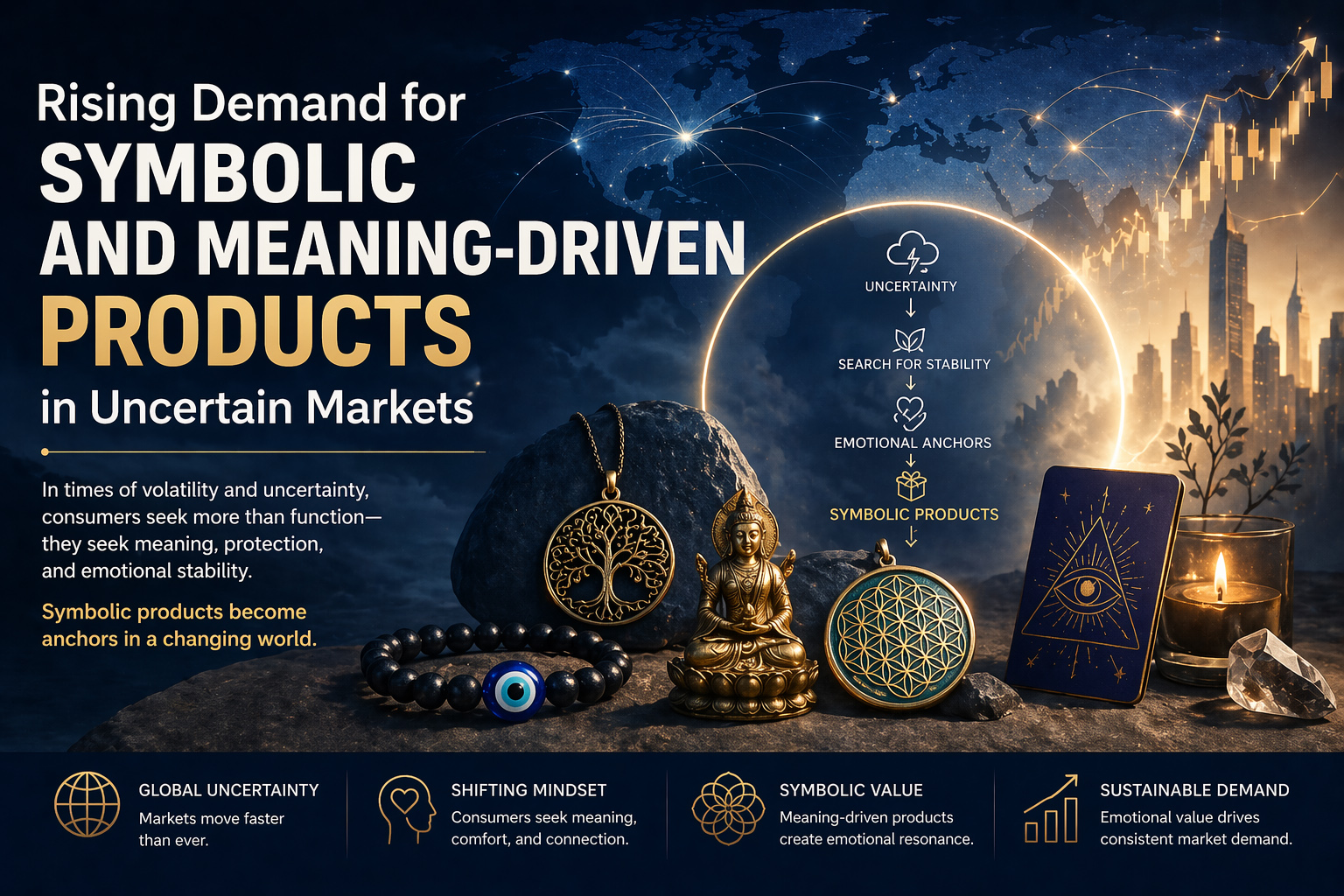
Rising Demand for Symbolic and Meaning-Driven Products in Uncertain Markets
In global markets, demand is not only shaped by price, function, or availability. It is also shaped by perception, emotion, and meaning.
As uncertainty increases across economic, technological, and social environments, consumer behavior is undergoing a structural shift. Buyers are no longer driven solely by utility—they are increasingly influenced by products that offer symbolic value and emotional resonance.
⸻
Uncertainty as a Demand Driver
Market uncertainty has become a defining condition of modern global trade.
Rapid technological change, volatile economic cycles, and fragmented information environments contribute to a constant sense of instability. In such conditions, consumer confidence becomes more fragile, and purchasing decisions become more psychologically driven.
Products are no longer evaluated only on function. They are evaluated on how they make consumers feel.
⸻
The Shift Toward Meaning and Emotional Value
As uncertainty grows, consumers seek anchors.
Symbolic and meaning-driven products provide a sense of identity, protection, belonging, or emotional reassurance. These products often carry cultural, aesthetic, or conceptual significance that extends beyond their physical function.
This shift does not replace functional demand—it adds a new layer on top of it.
⸻
Symbolic Products as a Distinct Market Layer
In structured wholesale systems, demand is typically categorized by product type, pricing level, or market segment.
However, symbolic demand introduces a different dimension.
Products can now be positioned not only by category, but by meaning:
• Identity-driven products
• Emotionally expressive products
• Culturally symbolic products
• Concept-based design products
This creates a parallel demand layer that operates alongside traditional wholesale structures.
⸻
Implications for Wholesale Strategy
For wholesale businesses, this shift requires a broader understanding of demand.
Sourcing decisions can no longer rely solely on price competitiveness or production efficiency. Product selection must also consider symbolic positioning, visual identity, and emotional relevance within target markets.
Wholesale systems that integrate symbolic demand into their assortment strategies can create stronger differentiation and more resilient retail performance.
⸻
Integrating Meaning into Structured Systems
Symbolic products must still operate within structured wholesale frameworks.
They require:
• Stable supply consistency
• Controlled inventory allocation
• Coordinated distribution strategies
The difference lies in how these products are positioned and distributed within the system.
When integrated properly, symbolic products enhance—not disrupt—structured wholesale operations.
⸻
Long-Term Demand Evolution
As global markets continue to evolve, demand will not become purely rational or purely emotional.
It will become layered.
Functional demand ensures usability.
Structural systems ensure stability.
Symbolic value drives engagement.
Wholesale systems that recognize and integrate these layers will be better positioned to adapt to future market conditions.
⸻
Conclusion
In uncertain markets, demand is no longer defined by function alone.
Symbolic and meaning-driven products represent an emerging layer of global demand—one that reflects deeper shifts in consumer behavior.
For wholesale systems, the ability to recognize and integrate this layer will be essential for maintaining relevance, differentiation, and long-term stability in an increasingly complex market environment.
⸻