
Cart
Your shopping cart doesn't have any products yet!

⸻
Why Structured Supply Chains Define Stable Wholesale Markets
Wholesale distribution plays a critical role in connecting manufacturers, distributors, and retailers across international markets. While wholesale trade is often viewed as a simple exchange of goods, sustainable wholesale systems rely on a deeper operational structure.
Without coordination between production capacity, logistics planning, and market demand, wholesale supply chains quickly become unstable. Delayed shipments, inconsistent inventory availability, and unpredictable dispatch schedules can disrupt retail operations and weaken long-term partnerships.
Structured supply chains exist to reduce this uncertainty.
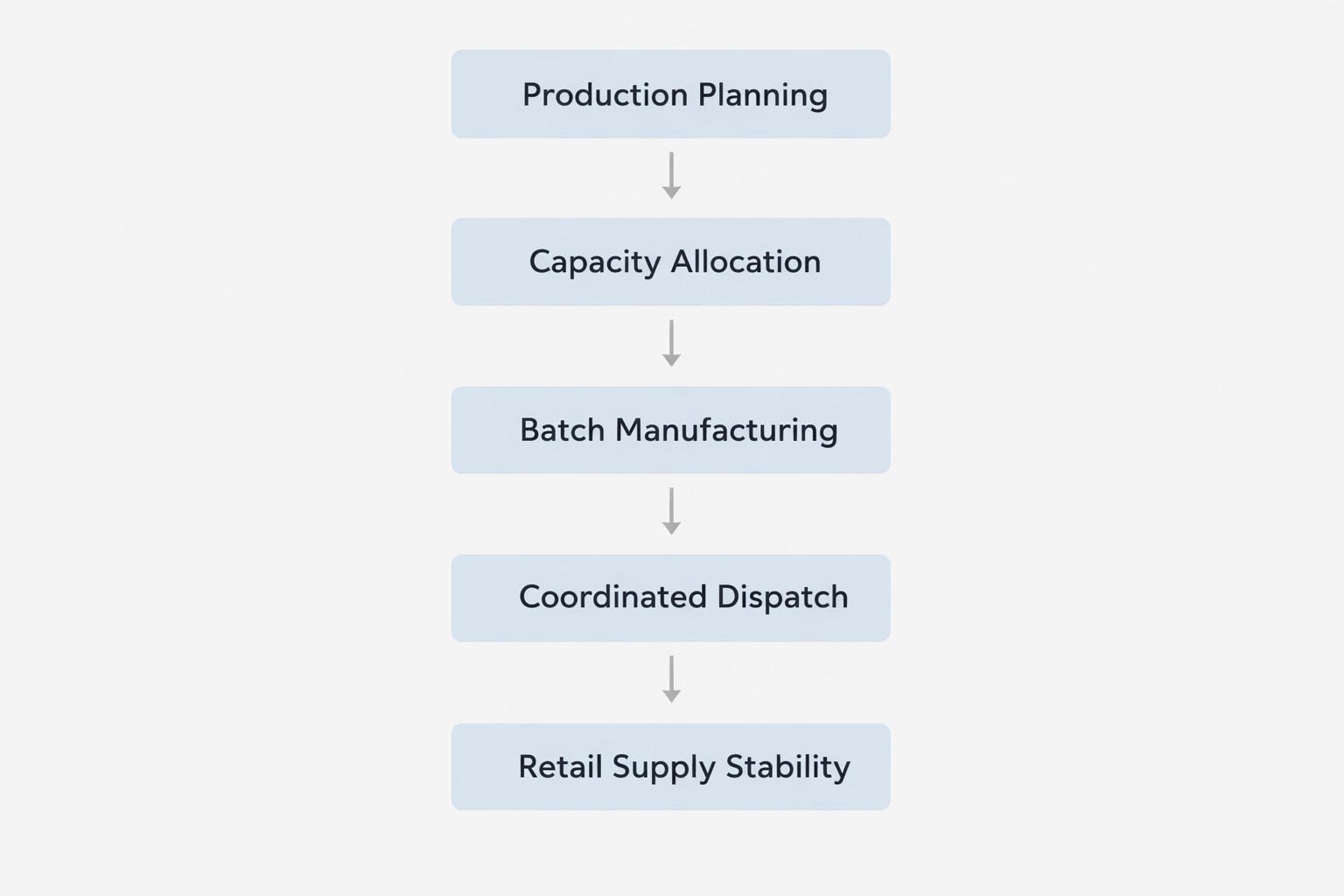
At the core of a stable wholesale system is production planning. Manufacturing capacity must be aligned with expected order volumes and seasonal demand cycles. Instead of reacting to orders randomly, structured wholesale networks allocate production slots and plan manufacturing batches in advance. This allows suppliers to maintain predictable output while ensuring retailers receive consistent inventory flows.
Beyond production, logistics coordination is another critical component of structured wholesale systems. Cross-border distribution requires synchronized documentation, shipping schedules, and routing management. When these elements are coordinated in advance, wholesale shipments can move efficiently across multiple regions without unnecessary delays.
Batch-based dispatch is also an important operational discipline in large-scale wholesale distribution. Instead of fragmented shipping, structured dispatch planning consolidates orders into organized shipment cycles. This improves freight efficiency while maintaining predictable delivery windows for retail partners.
In global retail markets, inventory stability is essential. Retailers rely on dependable supply cycles to plan merchandising, maintain product availability, and manage seasonal demand shifts. Structured supply chains support this stability by integrating production planning, logistics routing, and fulfillment coordination into a single operational framework.
Ultimately, successful wholesale partnerships are not defined by transaction volume alone. They are built on operational discipline, long-term coordination, and structured supply systems that prioritize reliability over short-term opportunistic trading.
As international retail markets continue to evolve, the importance of structured supply chains will only increase. Businesses that invest in disciplined production planning and coordinated distribution networks will be better positioned to support stable retail growth across global markets.
⸻