
Cart
Your shopping cart doesn't have any products yet!
⸻
Stability in Fragmented Trade Environments
In fragmented global trade environments, stability is no longer achieved through scale alone. It is achieved through structure.
As regulatory differences, logistics disruptions, and regional market shifts increase, wholesale operations must adapt to a more complex and less predictable system. Traditional single-structure models are becoming less effective in supporting stable cross-border trade.
⸻
The Limitations of Centralized Wholesale Systems
Operating through a single company, a single logistics path, or a single market exposure creates structural vulnerabilities.
When trade policies shift, financial channels are restricted, or logistics routes are disrupted, businesses relying on centralized systems may face delays, blocked transactions, or supply interruptions. In fragmented environments, concentration increases risk.
⸻
Distributed Structures in Wholesale Operations
To address these challenges, wholesale systems are evolving toward distributed structures.
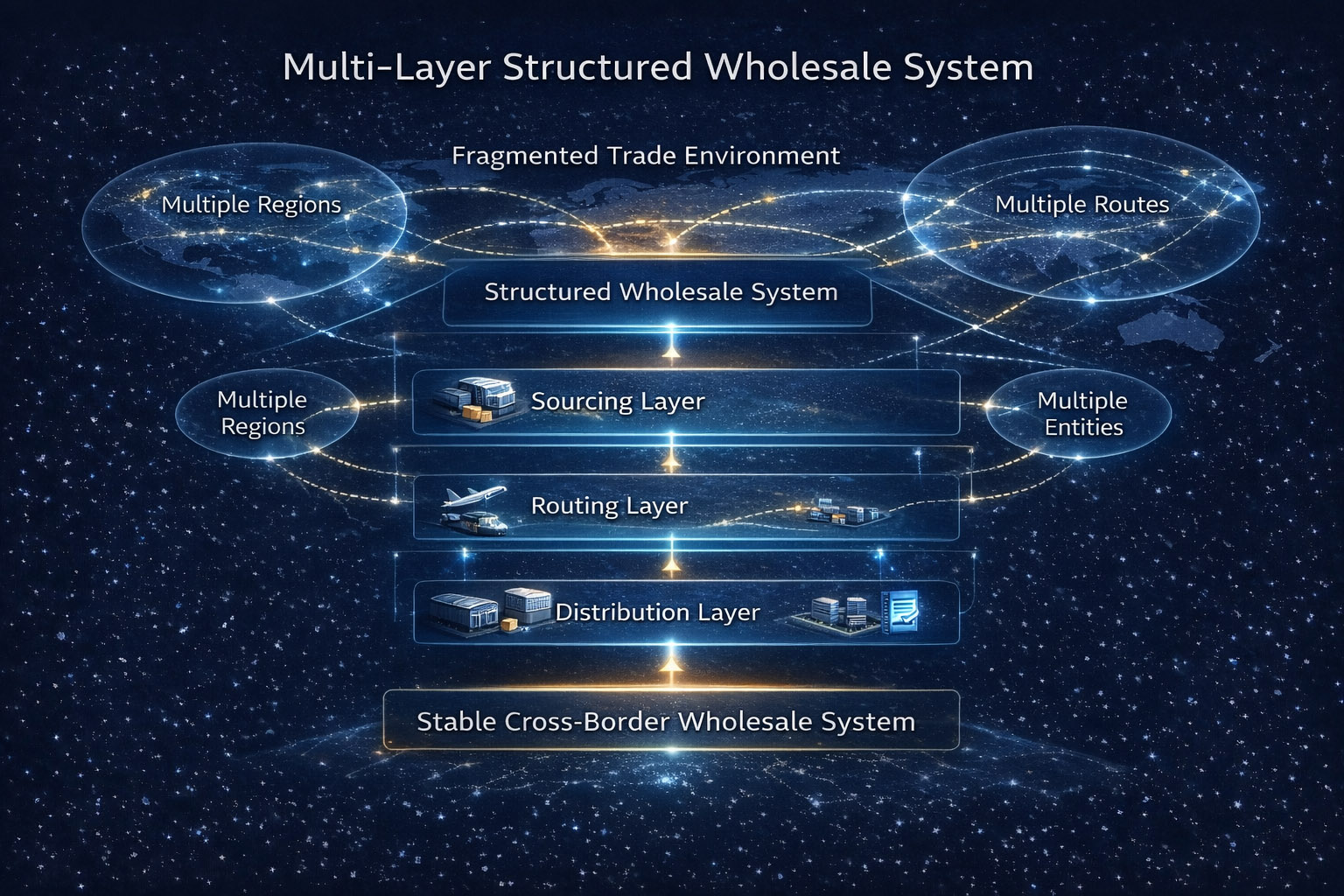
Instead of centralizing operations, businesses are separating sourcing, routing, and distribution across different regions and operational layers. This approach allows wholesale networks to operate through multiple pathways, reducing dependency on any single channel.
⸻
Multi-Layered System Design
In structured wholesale systems, different operational roles are allocated across multiple layers.
For example:
• Sourcing functions in one region
• Routing or transit coordination in another
• Distribution closer to target retail markets
By separating these functions, businesses reduce reliance on single jurisdictions and improve operational resilience.
⸻
Coordinated Structures for Stability
Structural distribution must be supported by coordination.
Wholesale systems need integrated planning across sourcing, logistics, and distribution layers. Coordinated scheduling, documentation alignment, and routing strategies ensure that distributed structures function as a unified system.
This coordination transforms fragmented operations into stable, predictable supply networks.
⸻
The Future of Structured Wholesale Systems
As global trade continues to evolve, structural adaptability will define long-term wholesale success.
Businesses that rely on rigid, single-channel operations will face increasing instability. In contrast, those that develop structured, multi-layered systems will be better positioned to manage risk, maintain supply stability, and support long-term international partnerships.
⸻